
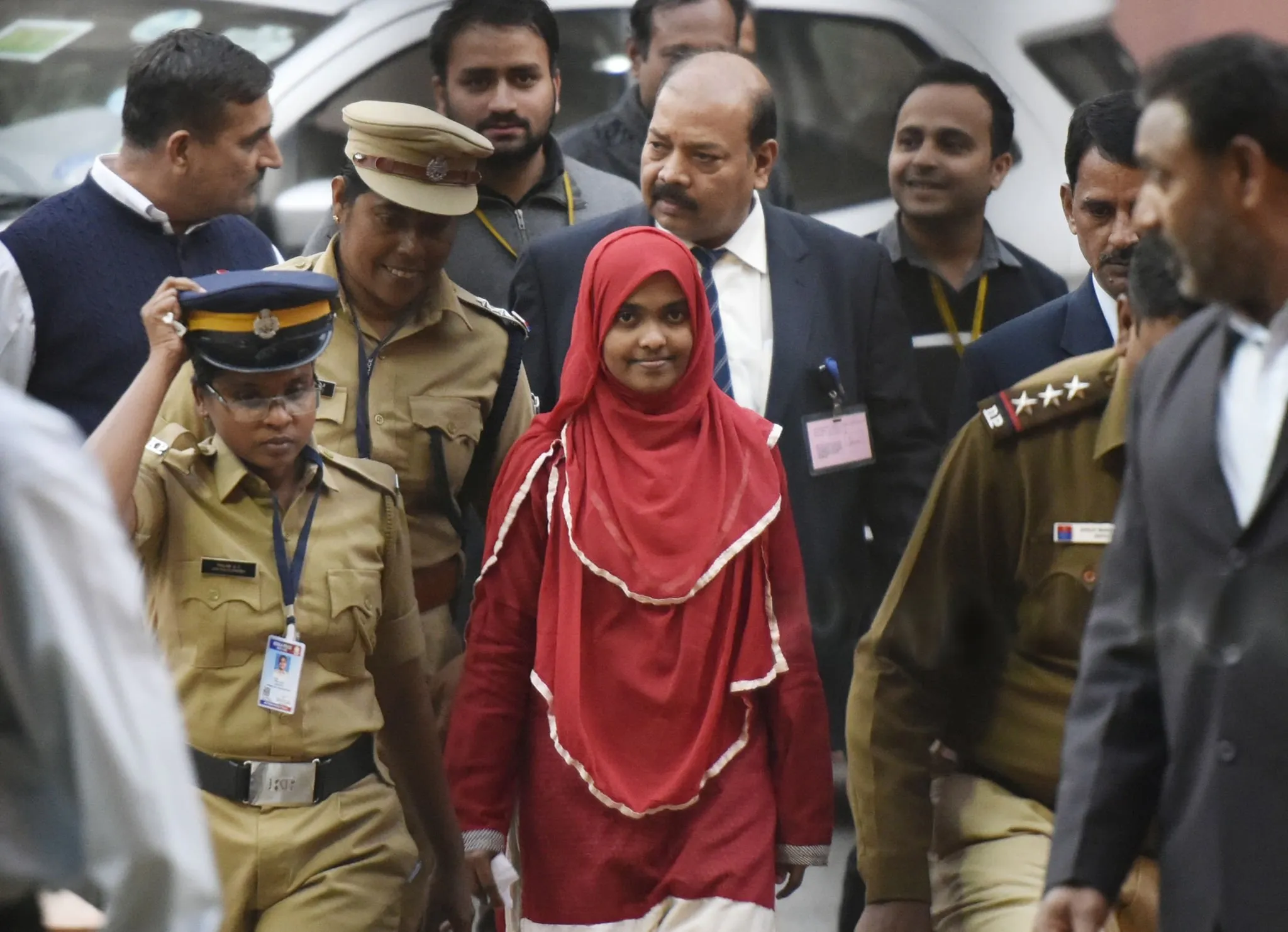
Can an individual be considered truly free if they may choose everything in life except the person with whom they wish to spend it?
Introduction
The case between Shafin Jahan v. Asokan KM, popularly known as the Hadiya Case, concerns interfaith marriage and a woman’s right to make independent decisions about marriage and the choice of spouse. The case gained prominence because of its association with the concept of ‘love-jihad’. The case does not confine itself to interfaith marriage; it brought a broader constitutional issue before the Supreme Court; to what extent can the family, society, state, and court interfere in an individual’s right to make personal choices?
Although marriage is traditionally regarded as a social institution, the Supreme Court viewed it through a constitutional lens, recognizing it as an expression of individual autonomy, privacy, dignity, and personal liberty. The Court stressed that an adult’s right to choose a partner constitutes part of an individual’s identity and of the liberty safeguarded under Article 21 of the Indian Constitution.
The case arose from a dispute over the marriage of Hadiya Jahan, who converted to Islam and subsequently married a Muslim man. Her father challenged her conversion and marriage, which had taken place without his approval or consent, by filing a habeas corpus petition. The Kerala High Court annulled the marriage and placed Hadiya in custody of her father. However, the Supreme Court ruled that the High Court had exceeded its jurisdiction and restored Hadiya’s liberty and marriage.
The judgment reflects a significant constitutional dialogue between individual autonomy and familial or social control, as well as between judicial paternalism and judicial protection.
Factual and Procedural Background
Ms. Akhila Ashokan, also known as Hadiya, was born into a Hindu family. She converted to Islam when she was studying for a Bachelor of Homeopathic Medicine and Surgery (BHMS) at Shivraj Homeopathic Medical College, Salem, Tamil Nadu. She began living with her friends Jaseena and Faseena. At the age of 24, she married a Muslim man named Shafin Jahan. In 2016, Hadiya’s father, Mr. Ashokan, found out about her religious conversion. In January, he filed a habeas corpus petition before the Kerala High Court on the ground that his daughter had forcibly been converted to Islam, or was allegedly involved in a larger conspiracy, or had an ulterior motive.
During the proceedings, Hadiya appeared before the High Court and declared that she had freely chosen to convert to Islam and to settle at the establishment of Sathyasarani Education Charitable Trust in Malappuram. Thus, the High Court observed that she was not unlawfully restrained by anyone and was free to make her own decision.
Following this, another habeas corpus petition was filed by her father, alleging that his daughter had been forcibly converted to Islam and was likely to be taken out of the country. The Kerala High Court ruled in favor of Mr. Ashokan and held that a father is responsible for maintaining custody of his daughter until she realizes the consequences of her actions. The Court invoked parens patriae jurisdiction and observed that it was in the best interest of a child of such age. The Court also stated that a 24-year-old girl may be easily manipulated and exploited, as they are considered weak and vulnerable. The Court, therefore, declared the marriage between Hadiya and Shafin Jahan null and void and placed Hadiya in custody of her parents, even though she did not consent.
Shafin Jahan filed an appeal before the Supreme Court challenging the order of the Kerala High Court. The Supreme Court ultimately restored their marriage.
Issues Before the Court
The principal legal issues were as follows:
- Whether the High Court, , in exercising its jurisdiction under Article 226 of the Indian Constitution, could annul the marriage of a competent adult.
- Whether an adult can freely decide on matters of religion or marriage without family intervention.
Submissions of the Parties
The judgment does not specifically record any arguments advanced on behalf of the Appellant. The Respondent, however, contended that the High Court was justified in invoking its parens patriae powers to protect Hadiya from the alleged risk of radicalization.
The Supreme Court’s Decision
In March 2018, the Supreme Court set aside the Kerala High Court’s decision to annul the marriage of Shafin Jahan and Hadiya, affirming the constitutional values of personal liberty and autonomy under Article 21 of the Indian Constitution. The Court held that, Hadiya being a major possessed the fundamental right, of great importance in a civilized society, to choose her religion and to marry the person of her choice, free from interference by family, society, or the court. It criticized the Kerala High Court for exceeding its judicial limits. It asserted that courts should respect an individual’s autonomy, and refrain from interfering paternalistically in personal decisions.
The Court acknowledged that both Hadiya’s conversion to Islam and her decision to marry were expressions of her free will, shielded by Article 25 of the Constitution, which guarantees freedom of religion. It allowed the National Investigation Agency (NIA) to continue its investigation into wider allegations of forced conversion. Still, it emphasized that such inquiries could not lead to interference in the marriage. In its final ruling, the Court declared the marriage valid and allowed Hadiya to live with her husband without fear. The three-judge Bench comprising Chief Justice Dipak Misra, Justice AM Khanwilkar, and Justice DY Chandrachud, removed Hadiya from her father’s custody, as it was against her wishes, and directed the authorities to ensure that she could continue her education after she expressed her wish to do so.
Critical Analysis
The ruling in Shafin Jahan v. Ashokan KM is significant because it places individual liberty at the center of decisions about religion, marriage and personal life. The Supreme Court recognized that a competent adult enjoys the constitutional freedom to make important personal life decisions, such as choosing a life partner and marrying. This approach reinforces the interpretation of Article 21 of the Indian Constitution by recognizing that the right to life and personal liberty does not merely encompass physical existence but also the freedom to make meaningful decisions about one’s own life.
One major strength of the ruling lies in the Court’s emphasis on the limited scope of habeas corpus jurisdiction. The primary purpose of habeas corpus is to assess whether a person is being unlawfully detained. During proceedings, when Hadiya appeared before the Court and voiced her wishes, the central concern regarding her continued detention fell away. As a result, the Supreme Court correctly distinguished between safeguarding an adult from wrongful detention and determining what the court considers to be in the adult’s best interest.
The judgment also strengthens the constitutional connection among individual liberty, privacy, and dignity. The choice of a life partner is an intimate decision that directly affects a person’s identity, family, and future. Judicial intervention in such cases therefore requires a valid legal basis; it cannot rest solely on social disapproval or family disputes. In this respect, the ruling aligns with the broader constitutional conception recognized in Justice K.S. Puttaswamy (Retd) vs Union Of India.
Another key aspect is how the Court treated marriage and religious choice as matters of personal liberty. Hadiya’s decision to convert to Islam and her subsequent marriage were closely intertwined with her exercise of individual choice. The judgment makes it evident that an adult’s decision regarding marriage or religion cannot be challenged automatically simply because it deviates from the expectations of the adult’s family or society. This is especially relevant in a diverse society, where people may make choices that defy traditional norms. However, the judgment does not imply that all marriages are exempt from legal scrutiny. Allegations of criminal activity, if any, could still be examined in accordance with law. The Court rejected the notion that such allegations, without supporting material, could justify curtailing the autonomous choice of a competent adult or bringing the validity of a marriage within the scope of habeas corpus proceedings. This distinction strikes a balance between protecting individual liberty and state’s duty to investigate criminal wrongdoing.
Overall, the case represents a significant development in Indian constitutional jurisprudence. The judgment goes beyond the specific circumstances of interfaith marriage because it affirms the wider principle that the personal choices of competent adults deserve constitutional protection. It also cautions courts against substituting their own or society’s perception of an appropriate life for individual autonomy. By limiting judicial interference in deeply personal decisions, the decision strengthens the constitutional principles of liberty, dignity, privacy, and freedom of choice under Article 21.
Conclusion
The Supreme Court described this case as a striking example of patriarchal control and the deep-rooted notion that women are objects to be controlled. The Supreme Court upheld the principles of autonomy, personal liberty, and dignity as essential constitutional values in the Indian Constitution. The ruling also reminds us that constitutional rights are not subject to social approval. Such a choice is constitutionally protected and cannot be curtailed merely because parents, communities, or society disapprove of it.
The judgment states that the right to marry a person of one’s choice under Article 21 and the freedom to choose or change one’s religion under Article 25 are fundamental rights enshrined in the Indian Constitution. Furthermore, both marriage and conversion of religion were valid, and the validity cannot be determined by the court if the individual has attained the age of majority. Each person is entitled to marry and enter into a legally valid contract after reaching the age of majority, without parental interference. Although the right to marry is not explicitly mentioned in the Constitution, it is recognized through interpretation as part of Article 21 of the Indian Constitution, which guarantees the right to life and personal liberty. As a result, the marriage between Shafin Jahan and Hadiya was valid, and the High Court’s decision to annul it was legally invalid.
- personal autonomy
- interfaith marriage
- right to privacy
- religious freedom
Cite this article
Apoorva Sharma, 'Autonomy Beyond the Family: The Right to Choose Faith and Spouse in Shafin Jahan v Asokan KM [2018] AIRONLINE 2018 SC 1136 ' (DraftLaw Research, 17 October 2026) <https://draftlawresearch.org/articles/autonomy-beyond-the-family-the-right-to-choose-faith-and-spouse-in-shafin-jahan-v-asokan-km-2018-aironline-2018-sc-1136/>
Copyright remains with the authors unless stated otherwise.
About the author

Undergraduate Student in Law , Panjab University, Chandigarh.