
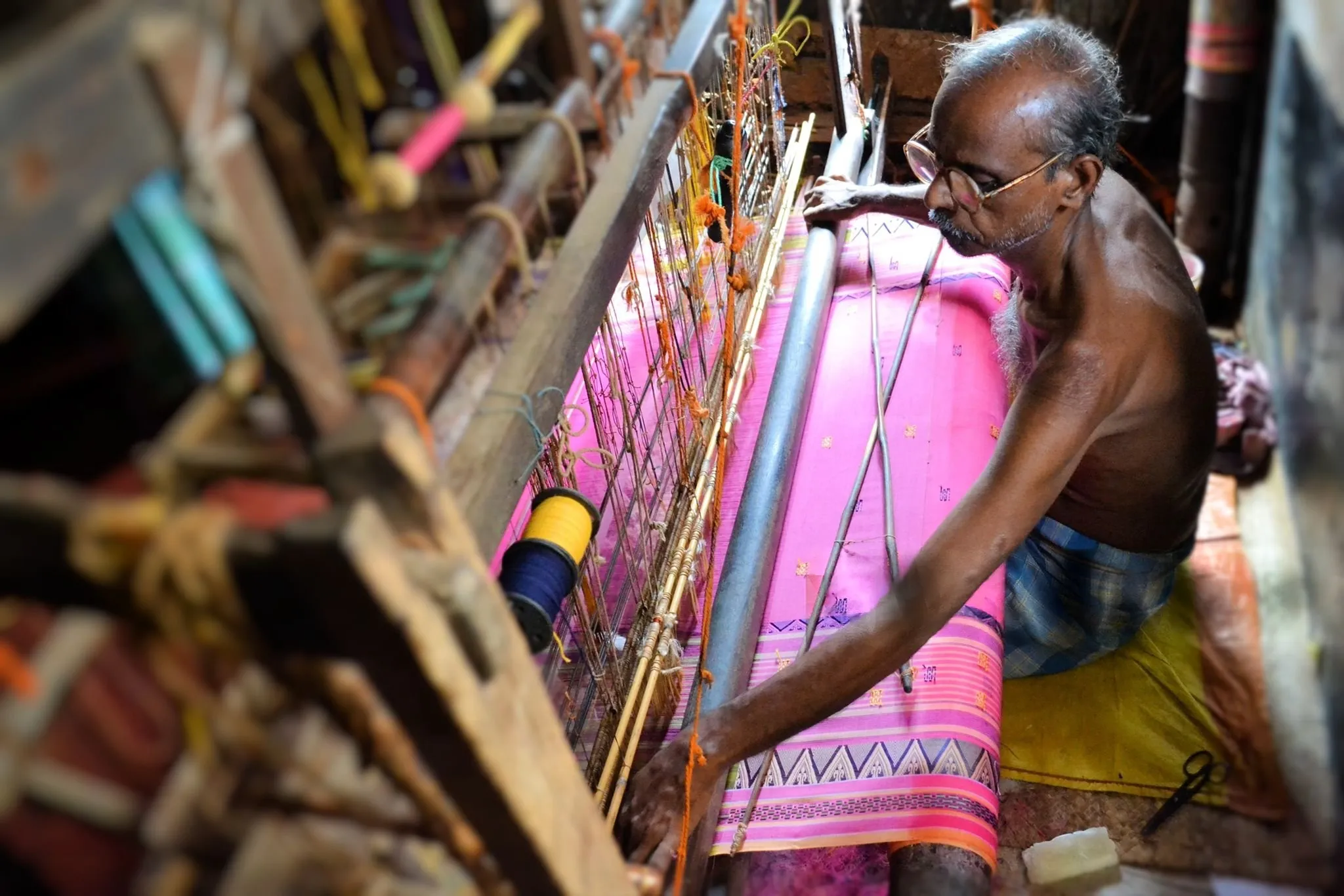
Geographical indications (GIs) protect names of products that are generally linked to places. It is now common for weavers to carry their skills across borders and build traditions in new production communities. The dispute around the Tangail saree asks how EU law should recognize those traditions when the name itself still points to another country. Most importantly, a claim based on local reputation needs evidence connecting the product to its new home, together with detailed scrutiny of what its name portrays and stands for.
Two Countries, One Shared Name
India’s GI register records “Tangail Saree of Bengal” with a certificate dated 2 January 2024, while Bangladesh’s register lists “Tangail Saree” following an application on 6 February 2024. The issue arises because both countries use the name of a district in Bangladesh, namely Tangail. It should be clarified first that these national registrations do not decide whether the names qualify for EU protection.
A 2017 study by Ruchira Ghose records Basak migration to West Bengal after Partition and the growth of different local weaving styles, but weaving continues in Bangladesh as well, where UNESCO’s 2025 inscription recognizes Basak and Jhola traditions. Still, that recognition concerns cultural heritage and does not automatically grant GI rights.
Enrico Bonadio, Magali Contardi and Nicola Lucchi have examined place-names carried abroad by migrants through food and drink disputes. In the Tangail debate, Debapriya Bhattacharya and Naima Jahan Trisha question whether transferred skills justify India’s claim. The EU’s newer rules for craft products allow this disagreement to be tested more precisely.
The question is this: can local reputation in West Bengal support EU GI protection for ‘Tangail Saree of Bengal’, and what limits arise from the name’s association with Bangladesh? Published product descriptions help examine that question but must be distinguished from proof of buyers’ understanding.
The Route to Protection Under Regulation (EU) 2023/2411
Regulation (EU) 2023/2411, applicable from 1 December 2025, covers craft and industrial products. Articles 21(c) and 22(3) provide a route for applicants outside the EU and require proof of protection in the country of origin. A national registration matters but does not bind the EU authorities.
Under Article 6(1), the product must originate in a defined place, with at least one production step there, and its quality, reputation or another characteristic must be essentially attributable to that origin. Thus, reputation is an alternative basis for the link, meaning that producers relying on it need not also prove distinctive physical qualities but must still be able to connect that reputation to the claimed area.
Anchoring Reputation in a New Territory
The May 2026 examination guidance of the EU Intellectual Property Office accepts a stable, evidenced reputation within the production area as satisfying the condition, and national or EU-wide fame is unnecessary. The evidence must connect the product to the name proposed for it, and the reputation must also exist when the application is submitted.
The main difficulty is that producers might benefit from Tangail’s existing prestige without building a reputation tied to West Bengal. Migration and continued weaving cannot settle that objection under the conditions described so far; an application must explain how the product’s standing has become connected to the defined territory, West Bengal in this case, including any local skills or practices on which that standing rests.
Dated trade publications could show that buyers recognize the West Bengal product under the proposed name and value its local production traditions. Sales records can show demand, but the condition of association needs to be explained by context, and neither a long weaving history nor a seller’s promotional claims automatically supply that context.
There is no requirement within Article 6 that the craft must be invented in the claimed area first, so producers do not have to deny Bangladeshi history or prove that every method has originated in West Bengal. On that reading, a shared history need not prevent a new geographical link, but it does, make evidence of that link essential.
Commercial Use vs. Buyer Recognition: The Evidentiary Record
An India Handloom Brand factsheet acknowledges that the name comes from Tangail in Bangladesh and records migrant production in West Bengal. Ghose’s 2017 study also records different styles at different West Bengal centers. Together, these records support movement and local adaptation. Neither establishes the current reputation of the product under the full proposed name.
The Indian applicant, Tantuja, uses ‘Tangail’ in its product description and describes changes to border patterns. That shows commercial use of the term. It does not establish a stable reputation for ‘Tangail Saree of Bengal’, or shows what buyers understand. A description of a weaving style is not automatically evidence of reputation under the full proposed name.
The national specifications identify further matters to investigate. India’s GI Journal 178 (pp. 20 and 24) describes a mix of Shantipur and Dhaka-Tangail designs and links the finish to local paddy and water. Bangladesh’s GI Journal 32 (pp. 7 and 9) identifies Tangail weaving localities and makes its own claims about water and climate. These are recorded claims, rather than independent findings. A reputation-based application must still demonstrate the required geographical link.
Perception Generic and Homonymous Names: The EU Consumer Perspective
Article 9(1)(a) permits the use of either of the name used in trade or everyday language for the product within the defined area, commonly known as the local name, or its geographical names. Therefore, the fact that Tangail, as a district, is located in Bangladesh does not, in itself, rule out a West Bengal claim based on established commercial usage, although that usage must be proved.
Article 42 bars generic, that is, names that have become common product descriptions in the EU. Widespread use in South Asia does not settle that question, as seen in the Feta judgment (2005), where the EU’s Court of Justice considered production, consumption and Greek associations in marketing cheese made elsewhere. Although the case concerned food, it illustrates why production outside the original area does not by itself erase a name’s geographical meaning.
Article 43, which governs homonymous names, may apply at a time when two names compete for an EU registration where and wholly or partly matching names identify different origins. It becomes relevant when an earlier name is protected in the EU or was applied for there and is later registered, but earlier national registration alone does not give either side priority in the EU.
Article 43 thus allows such names to coexist only if there is sufficient distinction in local and traditional usage and presentation, while taking account of fairness to producers and the risk of misleading buyers. Furthermore, it bars a name in this situation if it misleads buyers about origin even when it accurately names its own territory. Therefore, “Of Bengal” needs to be examined alongside origin labelling and marketing, and the same scrutiny would apply if the Bangladeshi name followed an earlier qualifying Indian name under the same rules.
The EU market matters at this stage because, where a formal objection is accepted for examination and remains unsettled, Article 29(4) requires its grounds to be assessed in relation to EU territory, and the Office’s guidance confirms the relevance of EU perception. Local recognition in West Bengal can therefore support a reputation claim without resolving how EU buyers understand the name.
Matching the Record to the Legal Test
In principle, local reputation can indeed support the West Bengal claim, but it must belong to the product under the proposed name and be essentially linked to the defined production area. The remaining origin requirements and the separate naming rules must also be satisfied. The published records help identify the issues, but they do not decisively determine the outcome of either claim.
The practical lesson for the migrant craft is to match each record to the question it can answer. A product description may show a name in use without proving buyers’ understanding; similarly, a weaving history may connect skills to a place without establishing present reputation. Reading each record this way allows a new local tradition to be recognized while preserving scrutiny of a name shared with producers elsewhere.
- geographical indications
- Tangail saree
- migrant craftsmanship
- EU intellectual property law
- geographical origin
Cite this article
Abrar-Bin-Shoukat Alvi, 'Can Migrant Craft Claim a Foreign Place-Name? The Tangail Saree Dispute and Regulation (EU) 2023/2411' (DraftLaw Research, 19 October 2026) <https://draftlawresearch.org/articles/can-migrant-craft-claim-a-foreign-place-name-the-tangail-saree-dispute-and-regulation-eu-20232411/>
Copyright remains with the authors unless stated otherwise.
About the author

Undergraduate Student in Law , Bangladesh University of Professionals