
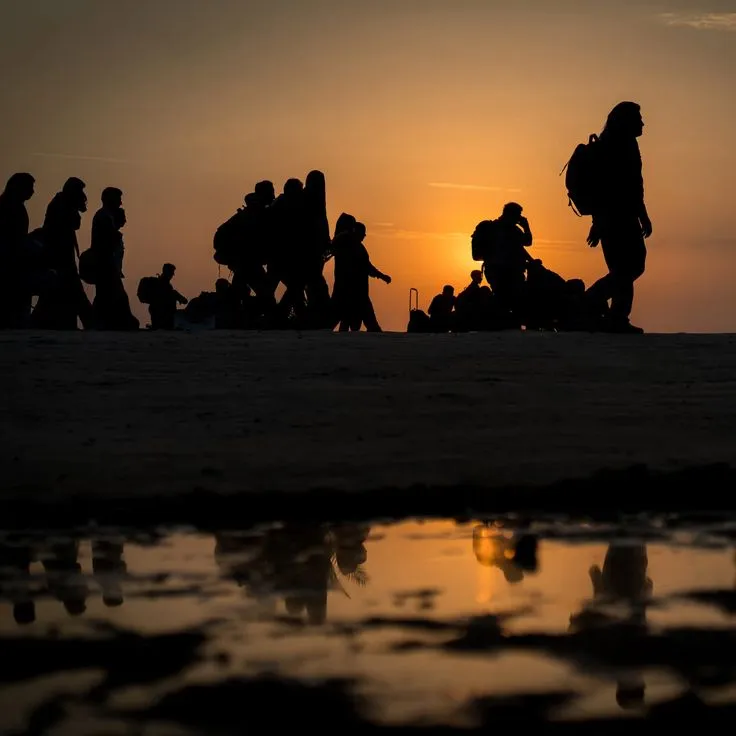
Climate change is a global phenomenon whose consequences for humanity have been widely discussed. Given recent findings that demonstrate the uneven effects of climate change on vulnerable communities, it becomes crucial that the relocation of these people preserve their rights guaranteed in both national and international frameworks. Thus, planned relocation programs organized by States emerge as a viable solution to secure individuals’ rights in climate mobility scenarios. However, such programs must be guided in detail and based on a human-rights respectful approach, as is suggested in the Inter-American Commission on Human Rights (IACHR) Resolution No. 2/2024.
Climate Change, Uneven Impacts and Climate Mobility
Climate change refers to ‘an alteration in the state of climate identifiable in variations in the mean value or in the variability of its properties, which persists for prolonged periods’ (IACHR, 2024, p. 5). Although it is a global occurrence whose effects may reach all States and regions, studies indicate that its impacts are unevenly distributed.
As environmental disasters’ effects are evident in circumstances that involve damage to fertile land, water, sea level, temperature and food security, the uneven distribution of impacts is evident. Populations and communities, such as indigenous people in high-risk areas and rural communities that depend on agricultural production for subsistence suffer greater impacts compared to other groups. Similarly, homeless and low-income people experience more devastating consequences induced by climate change due to inability and lack of resources to, for instance, relocate independently to safer areas. Therefore, the impacts of climate change are noticeable, among other factors, in both national and cross-borders human mobility. As stated in IDCM’s 2026 Global Report on Internal Displacement, ‘displacement is a result of unaddressed risks’, requiring investments in studies and evidence to reduce future displacement risks and improve the lives of those affected.
The human mobility induced by the effects of climate change was denominated as climate mobility, referring to which covers different types of human mobility, including: forced displacement, commonly associated with the involuntary flee of individuals residing in high-risk areas or post climatic disasters; migration, constituted by a partial voluntariness and planning by the community; and planned replacement, characterized by the States’ actions in supporting and organizing the relocation of people at risk.
Planned Relocation as a Rights-Protective Response
Some of the difficulties faced by cross-border climate migrants and displaced people include struggles to access basic necessities, as well as exposure to abusive working conditions, expulsion, social exclusion, violent attacks, torture and sexual exploitation (UNHCHR, 2018). These difficulties are evident in the analysis of mobility processes that occur out of necessity rather than free choice, commonly in contexts that lack proper planning and are led by members of the community.
In response to these difficulties and considering the predictions of an increase in the number of people worldwide who will be affected by climate change (IOM, 2009 qtd. in Garimella, 2022), planned relocation programs became a widely considered form of mobility process by international organizations. This type of population relocation is recommended as an alternative that may mitigate the struggles encompassed by the vulnerable.
Planned relocation consists of ‘a set of measures, actions, and activities implemented by the State’ ‘in order to move people or communities living in areas declared to be of high risk that cannot be mitigated to safer locations, away from such risk areas’ (IACHR, 2024, p. 6). Therefore, by involving the States in the coordination of the mobility process, the goal is to guarantee the protection of the individuals’ human rights.
One of the first concrete steps at the intergovernmental level towards the implementation of planned relocation programs was the adoption of the Cancún Agreements at the 16th Conference of the Parties (COP 16), which addressed the States by explicitly naming planned relocation within the framework for adaptation to the effects of climate change.
The Regulatory Gap and Recurring Challenges
However, the regulation and the establishment of how States should promote planned relocation programs were not addressed in detail. This normative gap left each State to design its own program, leading to difficulties that prevented the programs from succeeding. Based on the analysis of 12 concrete examples, Pranav Garimella identified the four main challenges encountered in relocating communities: political issues, associated with communities’ distrust with government action; legal and governance issues, concerning both insufficiency of existing norms and conflicts between established ones; human rights issues, which concern the violation of rights in relocation destinations and processes; and social/cultural issues, associated with the loss of communities’ cultural practices and discrimination (Garimella, 2022, p. 3). Consequently, the populations that the programs sought to protect faced new vulnerabilities, leading to the discernibility of States’ relocation programs.
IACHR Resolution No. 2/2024: Establishing a Human Rights Framework
Due to the necessity of establishing normative parameters, the Inter-American Commission on Human Rights Resolution no. 2/2024 emerges as a potential guide for the states that aim to improve and facilitate the assistance given to their citizens for safe and respectful mobility.
Safeguarding Rights in Planned Relocation
Regarding the political challenge, the Resolution requires States to guarantee accessible public information concerning the consequences that may be faced by affected communities, to ensure participation of people at risk of displacement in the organizational process, allowing active role in decision-making (IACHR, 2024). Implementing these propositions contribute to promoting people’s trust in government actions, since people are heard instead of being subjected to the imposition of pre-designed plans.
As to the legal and governance issues, the Commission establishes that States must adopt mechanisms to guarantee migratory regularization, such as providing adequate documentation for people who arrive in their territories, seeking to eradicate statelessness and the consequent insecurity (IACHR, 2024).
Concerning human rights issues, the provisions include not only housing, but also access to basic human rights, such as education, health and restoration of employment into the planned relocation’s objectives. In order to best secure such rights, the Commission highlights the access to an effective judicial remedy to act upon non-compliance with prior agreements. Through these guarantees, States’ relocation programs will safeguard rights to which the individuals had access to in their original location, thereby securing the principles of non-regressivity and non-derogability (IACHR, 2024).
Lastly, as to social and cultural issues, the Resolution requires respect for the culture and traditions of relocated people, emphasizing the importance of preserving identity elements and suggesting opportunities for integration between relocated and host communities. By adopting such measures, States will encounter fewer challenges concerning the preservation of the culture and social aspects of the relocated population, since a community that encourages the interaction among its members is more prone to promoting respect between individuals, reducing discriminatory circumstances.
Interstate Cooperation and Advisory Opinion OC-32/25
Essentially, the Resolution promotes cooperation and coordination between States, encouraging them to establish prior guidelines in order to facilitate possible occurrences of relocation. Among such guidelines, the document suggests: creating systems to exchange information concerning difficulties faced due to climatic risks; establishing cross-border contingency plans, aiming to facilitate the process of entering States’ territories; and providing adequate training for migration authorities. Such recommendations must be interpreted in the light of the Advisory Opinion OC-32/25 of the Inter-American Court of Human Rights (IACtHR), which recognized States’ obligation to enforce measures under the American Convention on Human Rights and align national policies with science-based climate evidence, highlighting the importance of state cooperation and coordination (IACtHR, 2025).
Concluding Remarks
In conclusion, although States’ pioneering attempts to organize and promote planned relocation programs presented several challenges and difficulties, which led to communities’ disbelief on the efficiency of this approach, the Inter-American Commission on Human Rights Resolution No. 2/2024 still enables governments to adequately move populations away from climate-change sensitive areas.
- climate mobility
- planned relocation
- IACHR Resolution No. 2/2024
- climate change
- vulnerable communities
- state obligations
- interstate cooperation
Cite this article
Lívia Archanjo Deretti, 'Climate-Induced Planned Relocation: Guidance from IACHR Resolution No. 2/2024' (DraftLaw Research, 15 October 2026) <https://draftlawresearch.org/articles/climate-induced-planned-relocation-guidance-from-iachr-resolution-no-22024/>
Copyright remains with the authors unless stated otherwise.
About the author

Undergraduate Student in Law , Pontifícia Universidade Católica do Paraná (PUCPR)