
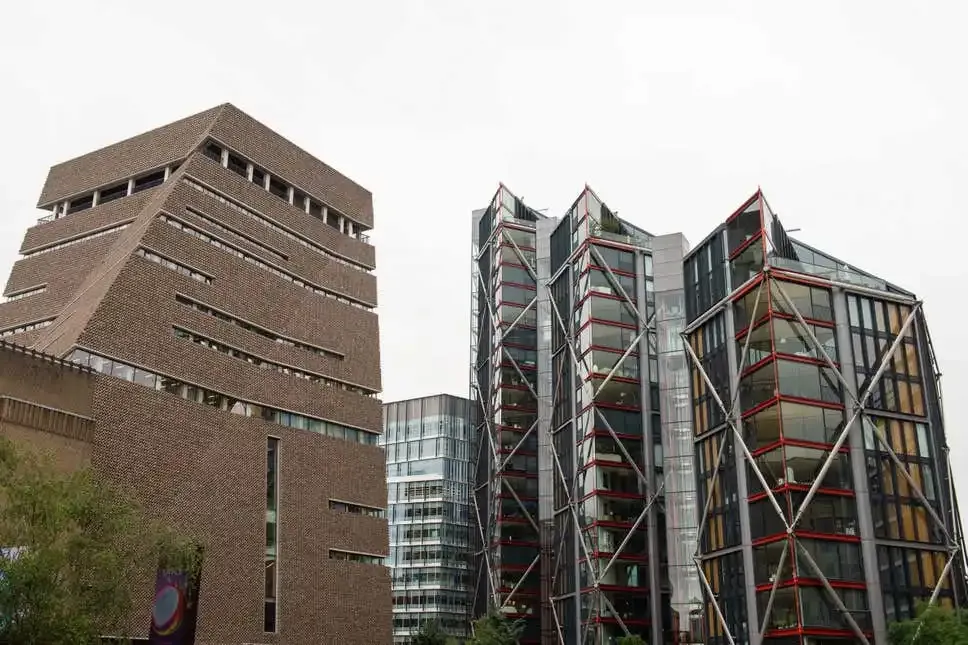
The claimants in this case were long leasehold owners of four high-end flats in Neo Bankside, located on the south bank of the River Thames near the Tate Modern. Each flat had floor-to-ceiling glass ‘winter gardens’ originally intended as enclosed balconies, but later incorporated into the main living spaces, leaving the interiors fully visible from the outside. Around the same time, the Tate Modern built an extension, the Blavatnik Building, which included a public viewing gallery on its top floor. The gallery attracted thousands of visitors each year, offering panoramic views of London. However, visitors could also see directly into the claimants’ flats, only 34 meters away. Many were found to look inside, wave and take photographs, despite signs urging them to respect residents’ privacy.
The claimants complained that this constant public observation severely interfered with the enjoyment of their homes, amounting to a visual nuisance. The critical issue, as framed by the courts, arising out of these factual developments was:
Does the visual intrusion caused by the Tate Modern’s use of the top floor of the Blavatnik Building as a viewing gallery amount to a private nuisance?
In the High Court, in 2019, Mann J accepted that interference with privacy through overlooking could, in principle, constitute the tort of nuisance. He relied on Thompson-Schwab v Costaki [1956] 1 WLR 335, in which the Court of Appeal held that the sight of prostitutes could amount to a nuisance because it offended ordinary comfort. He noted that there was no binding English authority establishing that mere overlooking could never constitute a nuisance. He further considered that the common law could develop in light of Article 8 ECHR, which protects the right to respect for private and family life, home and correspondence. Nevertheless , he dismissed the claim, finding that the Tate Gallery’s use of its land was reasonable in an urban setting , and that some overlooking was therefore foreseeable. The claimants could have taken simple measures, such as installing net curtains or privacy film, to limit the overlooking. While the gallery did interfere with their privacy, Mann J concluded that this did not amount to an unreasonable use of land sufficient to establish nuisance. This conclusion led the claimants to appeal before the Court of Appeal.
Upon the claimants’ appeal to the Court of Appeal, Sir Terence Etherton MR, Lewison LJ and Rose LJ in 2020, upheld the dismissal on different grounds. It relied on the overwhelming weight of authority, affirming the principle that mere overlooking is not actionable in the tort of nuisance. The Court also distinguished visual intrusion from traditional forms of nuisance such as noise, smell and smoke, noting that visual intrusion is subjective and lacks an objective standard for establishing unreasonable interference. It stated that issues relating to overlooking could be better dealt with through the planning system rather than through private litigation. In addition to that, the Court rejected reliance on Article 8 ECHR, stating that extending nuisance law to protect privacy would distort the law of tort. Accordingly , the Court of Appeal dismissed the appeal and confirmed that the claimants had no cause of action for a claim of private nuisance.
The claimants then appealed to the Supreme Court, which allowed the appeal by a majority of three to two in 2023, overturning the Court of Appeal’s rejection of overlooking as private nuisance. All the justices agreed that visual intrusion could in principle be actionable. The majority of the judges, including Lord Leggatt, Lord Reed and Lord Lloyd-Jones determined that the Tate Gallery’s viewing gallery constituted a substantial interference with the claimants’ enjoyment of their homes and was not a ‘common and ordinary use’ of the land. The majority emphasized that protection from nuisances protects the use and enjoyment of land from unreasonable interference, including intrusions on privacy and comfort, and that physical elements are not necessary. Applying the ‘common and ordinary use’ test, the Supreme Court found that encouraging thousands of visitors to look directly into neighboring homes went beyond acceptable neighborly relations and amounted to an extraordinary use of land. Although Article 8 ECHR was not directly applied, its underlying values reinforced the importance of residential privacy. The majority held the Tate Gallery liable in private nuisance and remitted the question of remedy to the High Court.
The ratio decidendi of this landmark case is that intense visual intrusion and constant overlooking can constitute an actionable claim for private nuisance. The test is whether the visual intrusion is “extraordinary, abnormal and substantially interfering”. The claimant must show a substantial interference, and the defendant’s use must go beyond the common and ordinary use of land.
The Supreme Court’s decision to dispense with any requirement that interference be physical is an integral and fair change in the law of private nuisance. The main point was how people use and enjoy their land, not whether the interference was physical or not. This makes sense, since nuisance has always been about more than what can be touched. This reasoning aligns with the precedent from Sturges V Bridgman [1879] LR 11 Ch D 852, which holds that liability depends on whether the interference is reasonable in the circumstances and not on the kind of interference. The majority of the Judges affirmed this by applying the common and ordinary use of land test. However, the decision might push nuisance law towards privacy, which could somewhat distort the law and blur the line between property-based nuisance and privacy law.
The dissenting judges, Lord Sales and Lord Kitchin, argued that nuisance should not take the place of privacy law. They stated that such disputes are better handled by planning controls than by stretching nuisance law. Lord Sales’s dissent turned mainly on reasonable reciprocity and an objective standard of reasonableness. However , the dissent’s point that the claimants’ choice to live in glass-walled apartments contributed to their exposure , is not very strong. Accepting it would mean that people must give up the freedom to live in their homes as they choose merely because of how those homes are built, which is not really fair.
The majority Judges’ focus on the unusual and extraordinary nature of the Tate Gallery’s activity does show a limit. The decision does not turn every case of overlooking into a nuisance. It affirms only that substantial interference can constitute a nuisance.
I consider decision a welcome change to the law of nuisance, though not necessarily an expansion of it. This decision shows the Court departing from a strict rule towards an approach that looks at the real situation and the right being protected.
In conclusion , Fearn V Board of Trustees of the Tate Gallery [2023] UKSC 4, represents a significant development in the modern law of private nuisance by rejecting the rigid assumption that interference must be physical. The Supreme Court’s approach is persuasive because it focuses on the substance of the interference rather than its physical form. This allows nuisance to respond to contemporary legal challenges, and it reflects the need for flexibility in the common law to adapt existing principles to changing social conditions. However, its long-term impact will depend on how consistently the common and ordinary use of land test is applied.
- private nuisance
- visual intrusion
- residential privacy
- tort law
Cite this article
Ankita Farzin , 'Visual Intrusion and the Boundaries of Private Nuisance: A Case Commentary on Fearn v Board of Trustees of the Tate Gallery [2023] UKSC 4' (DraftLaw Research, 17 October 2026) <https://draftlawresearch.org/articles/visual-intrusion-and-the-boundaries-of-private-nuisance-a-case-commentary-on-fearn-v-board-of-trustees-of-the-tate-gallery-2023-uksc-4/>
Copyright remains with the authors unless stated otherwise.
About the author

Undergraduate Student in Law, , University of London