
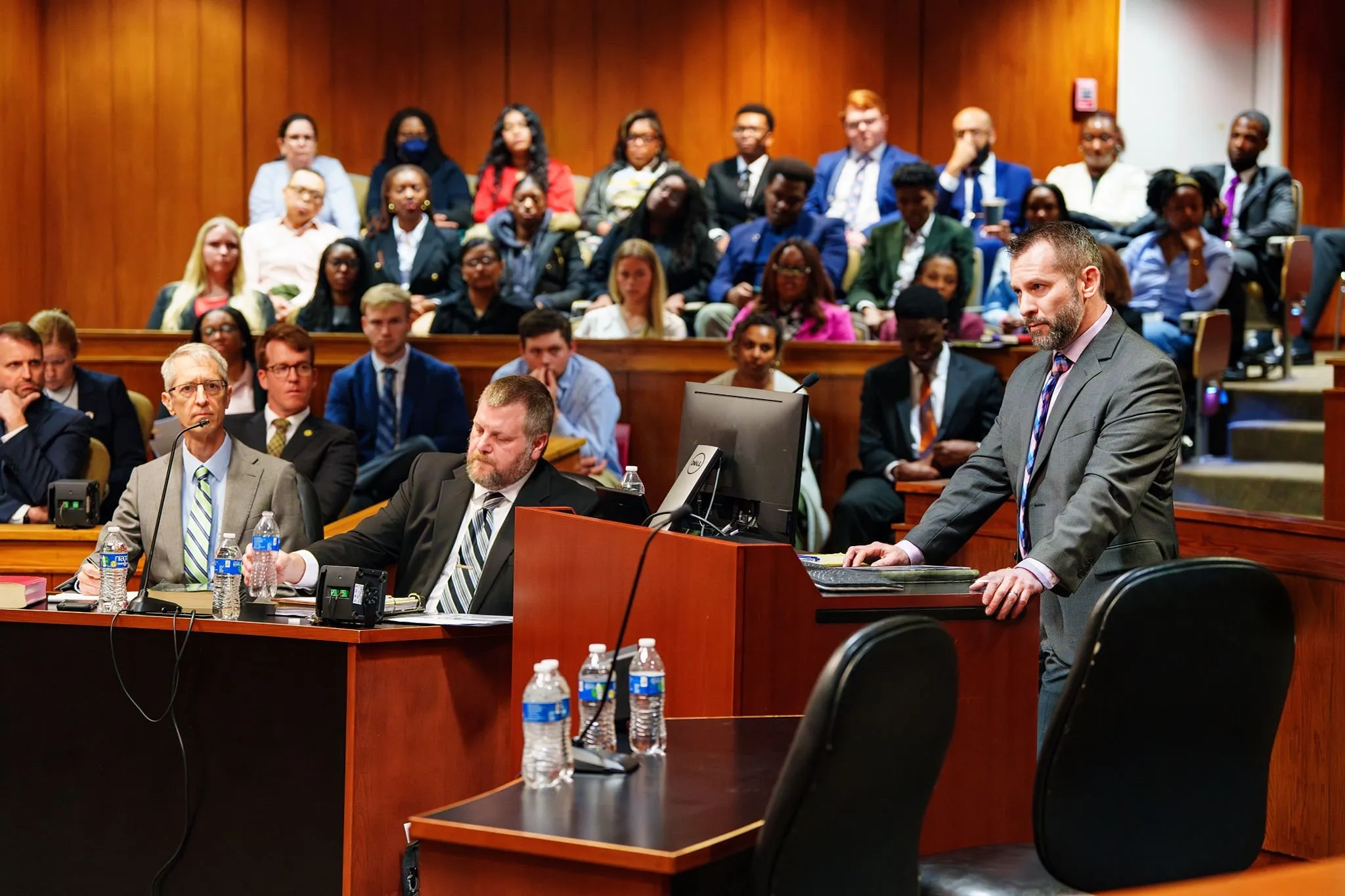
How to Handle Judges’ Questions
Questions are the heart of a moot. They are not an attack. They are the judges’ way to test whether you really understand your case. Strong speakers’ welcome questions and use them to make their best points.
Why judges ask questions
- To clarify something that was unclear.
- To test the weakest part of your argument.
- To explore what happens in a different situation (a “what if…?”).
- To check the facts or a source.
- To help you with a better argument.
- To move you on when you are repeating yourself.
When a judge interrupts, they are giving you free attention. Use it.
The five-step answer
- LISTEN : Let the judge finish. Never interrupt.
- PAUSE : One or two seconds. Think about the real concern.
- ANSWER : Give the direct answer first (yes, no, or the main point).
- BACK IT UP: One reason, one source or one fact.
- BRIDGE : Link back to your argument and continue.
Never start with a long story. Start with the answer. The judge should hear “Yes, because…” or “No, because…” within five seconds.
Understand the question
| Your situation | What to do |
| You did not hear the question | “I regret I did not catch that. Could the Court please repeat the question?” |
| You heard the words but not the meaning | “Could the Court kindly rephrase the question?” |
| You think you know the concern but are not sure | Say it back: “If I understand the Court’s concern, it is whether… ” Then pause one second, and answer. If the judge corrects you, adjust |
| Two meanings are possible | “Is the Court asking about X or about Y?” |
Saying the question back also buys you a few seconds to think, and it shows you were listening.
Four ways to structure an answer
1. A single direct answer. If the answer is simple, give it and stop.
Judge: “Is an email a written notice?”
You: “Not in these circumstances, Madam President. Article 12 requires notice to the other party, and this email went to one official, not to the State.”
2. A multi-point answer. State the conclusion, then the reasons.
“It is not, for three reasons. First, … Second, … Third, …”
3. A main point and an alternative. Defend your main position, then add a fallback.
“The treaty is still in force because notice was invalid. In the alternative, even if the Court finds the email valid, it came late, so the treaty is still renewed.”
4. A direct answer and a supplementary point. When your answer is not strong, still answer first. Then add a point that redirects the concern.
“It is correct that Article 4 does not mention emergencies. But the Court’s concern is answered by Article 9, which provides a special procedure for dry-season shortages, and Ulka did not use it.”
Do not dodge. If you avoid the question, the judge will ask it again.
Common question types and how to answer them
| Type | Example | How to answer |
| Clarifying | “Is your argument that the treaty is void, or just that it has not ended?” | Answer exactly. “The Applicant’s case is that it has not ended.” |
| Fact check | “Where do the facts say Ulka held back the flow?” | Give the paragraph number. “Paragraph 9, my Lord.” |
| Source check | “What is your best authority for that?” | Name the case or treaty, pinpoint, one sentence on what it says |
| Testing the weak point | “Article 12 does not mention diplomatic channels. Why should the Court add that requirement?” | Concede what is true, then explain. “It does not, but the Court reads treaty words in context and in the light of their purpose.” |
| Hypothetical | “If Ulka had sent registered post two weeks late, would you still win?” | Accept the new facts. Apply your rule. Show your rule gives a sensible result |
| Policy | “If we accept your view, will States ever be able to end river treaties?” | Show your rule is balanced. “Yes, by giving clear notice in time.” |
| Relief | “What exactly do you ask the Court to order?” | State the order in one sentence. Know your prayer by heart |
| Curveball | A question on a topic you did not prepare | Use first principles and your theory of the case. Try an answer. Do not freeze |
Answering hypotheticals
Do not say, “That is not our case.” The judge knows. The question tests whether your rule works in other situations.
Method:
Accept the change → apply your test → give the result → show it still fits your theory.Judge: “Suppose Ulka had told Torsa’s ambassador in person, but not in writing.”
You: “Then the written-notice requirement in Article 12 would still not be met. The parties chose a written form to avoid disputes about what was said. Our test is the same: a clear, formal, written notice to the State.”
If the hypothetical shows a flaw in your argument, you may adjust it slightly (“The Applicant’s position is better put as…”). It is better to adapt than to defend something that now looks silly.
When you do not know the answer
- Try. Give your best reasoning from the law and the facts. Judges give some credit for effort.
- If you really cannot answer, say clearly: “I regret I am unable to assist the Court on that point.”
- Do not bluff. Do not invent a case. Do not promise to “come back to it” unless you will.
When you make a mistake
Say, “I stand corrected.” Give the right answer quickly and continue. If the mistake changes your submission, fix the submission: “I stand corrected. The correct test is X, and applying it here…” Do not apologize for a long time. Do not argue with the judge.
When the judge asks about something you plan to say later
Do not say, “I will come to that later.” The judge wants the answer now. Better options:
- Bring it forward. “I will answer that now by turning to my third submission and then return to my first.”
- Short answer now, detail later. “The Respondent’s position is X. I will develop this under my third submission.”
When the question is about your teammate’s issue
Give a short answer if you can. “My co-counsel will address this in detail, but in summary, the Applicant’s position is…” If you do not know, say so and point to your co-counsel.
When the judge helps you
Sometimes a judge suggests a better argument for you. Take it if it is good and build on it so it shows you understand it. But be careful: do not accept an argument that goes further than your case needs, or that opens a new weakness. You may say, “If the Court accepts that, it supports the Applicant. The Applicant’s primary submission is a narrower one, which is…”
When to concede
Do not defend a point that cannot be won if conceding it costs you nothing. A calm concession builds trust.
Formula:
We accept X. But X does not change the result because Y.Never concede the heart of your case.
When the judge is hostile or silent
- Hostile or fast questions. Stay calm. Say “respectfully”. Answer one question at a time. Keep your voice steady. Your frustration should not be visible in your face, voice or demeanor.
- Silent bench. Do not panic. Keep explaining. Use your own signposts and ask, “Would the Court like me to expand on this point?” only if it helps.
- A judge cuts you off to change the order. Follow the judge’s order. Their order is the right order.
Do not do these
- Do not interrupt the judge, even to “save time”.
- Do not say “That is a good question”.
- Do not give long speeches. Answers should be short and direct.
- Do not repeat your whole argument in each answer.
- Do not read your notes while answering. Look at the judge.
- Do not guess a case name or a number. Say you cannot be sure.
Practice drill: the 30-second answer
Write 20 hard questions. For each, answer in 30 seconds or less using the five-step answer. Record yourself. Listen back. Does the answer begin with the answer? Does it include one source? Does it return to your case? Repeat until all 20 are smooth.
Copyright remains with the authors unless stated otherwise.
About the author

Founder, DraftLaw Research, Lund University