
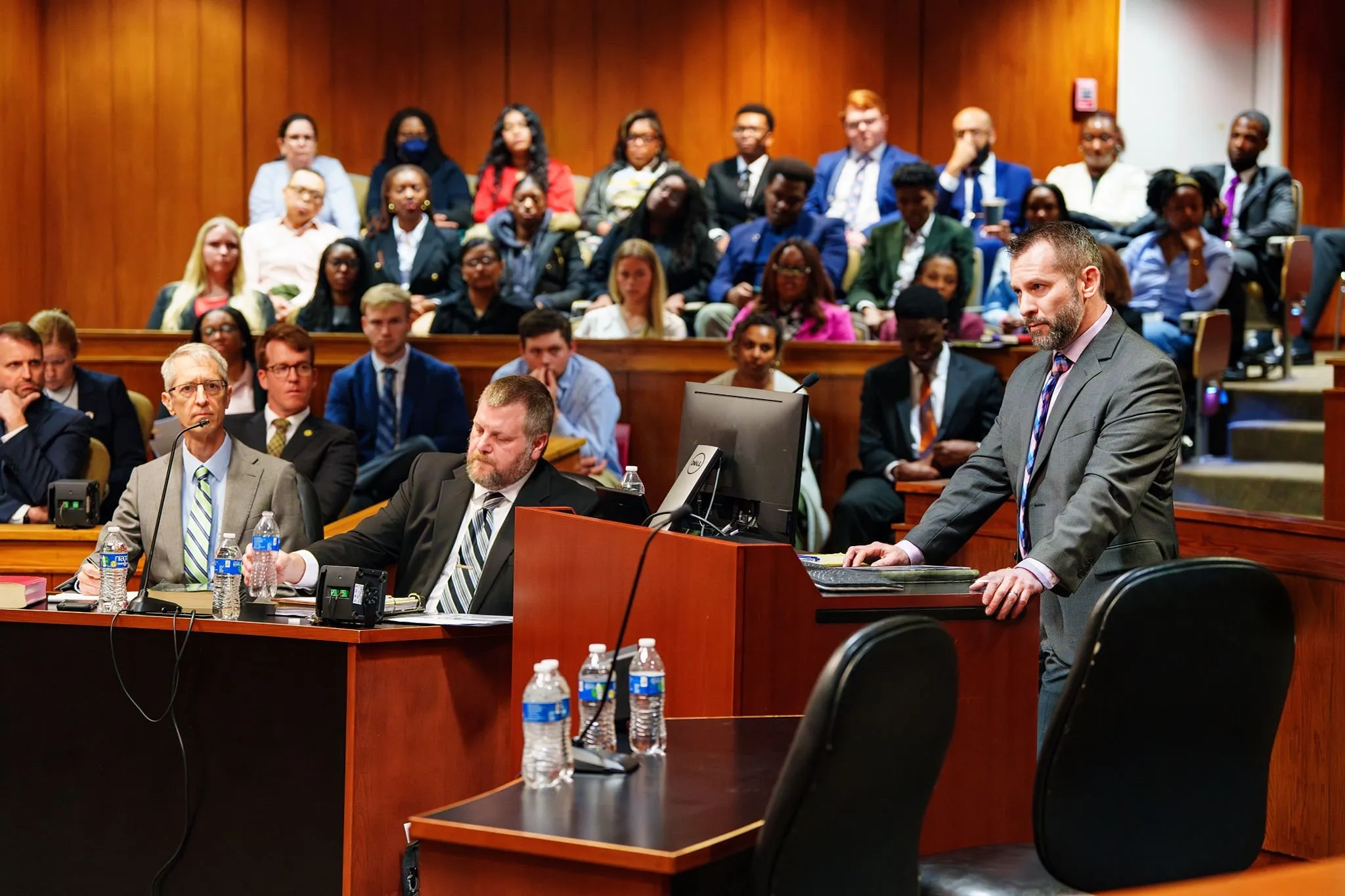
Tips and Tricks for Oral Rounds
These are small habits that make a big difference. Pick five to work on first. You cannot fix everything at once.
The first sixty seconds
- Start loudly enough and slowly. A confident start calms you down.
- Make the roadmap short and claim-based (“First, the treaty is still in force because…”). Judges relax when they know where you are going.
- If you have a weak point, tell the judges when you will deal with it. Judges often jump ahead to a weak point if you seem to avoid it.
Make your case easy to remember
- Use a theme. One short sentence the judges can repeat. Example for Torsa: “A river treaty cannot be ended by a single email.” Say it at the beginning, in the middle and at the end.
- Say what matters. After each point, add a short “so what?”: “This matters because, if Ulka is bound by Article 4, it has already broken it.”
- Use the rule of three. Three reasons are easier to follow than seven.
- Use small examples. One real-world or fact-based example makes an abstract rule easy to understand.
- Avoid empty words like “obviously”, “clearly” and “it is trite law”. If it were obvious, you would not need to argue.
Hard points first
Only if nothing else decides the order, begin with your hardest point. You will have the most time to explain it, and the judges will not feel you are hiding it. If you start with an easy point, a judge may still ask about the hard one in the first minute.
Reading the judge
- If a judge is writing, slow down and repeat your key point.
- If a judge looks confused, stop and restate it in simpler words. (Only for your priority arguments, in other cases ask the bench whether it is needed in a respectful manner)
- If a judge nods, do not rush ahead. Pause and let it land, then move on.
- If a judge asks the same question twice, your answer was not clear. Rephrase it. Do not repeat the same words.
- Use the judge’s own words when you answer. It shows you listened.
Time control (without saying it aloud)
- Keep a stopwatch where you can glance at it without moving your head.
- Plan your priority points so you can shorten the speech smoothly.
- Do not say “in the interest of time” or “I only have a few minutes”. It tells the judges your plan failed. Just move on.
- If your time ends, politely ask, “May I have thirty seconds to conclude this point?” or “May I answer the Court’s question?” Do not start a new point.
English, accent and names
Most non-native students speak English as a second or third language. That is normal. Judges care about clarity, not accent.
- Slow down. A slightly slower pace makes any accent easier to understand.
- Say each key legal name clearly. Practice names such as Gabčíkovo-Nagymaros, Corfu Channel, Pulp Mills, Nicaragua, Barcelona Traction, Lotus with a teacher or by listening to recordings of ICJ hearings.
- Prepare simple English for hard ideas. If you cannot say it simply, you may not understand it yet.
- Do not switch to Bangla in the round, even among teammates, even if the rules allow it. Do not switch even when the round ends, it will keep you in a familiar mindset.
- Avoid direct translations of Bangla expressions. Say “The Applicant relies on…” rather than “The Applicant is dependent on…”.
- If you do not understand a word, ask: “Could the Court kindly repeat or rephrase?”
Working as a team in the room
- Sit tall and look attentive when your co-counsel speaks. Judges are watching you.
- Pass short notes only: a page number or a keyword. Do not whisper.
- If your co-counsel makes a small error, do not correct it in front of the judges. Fix it in your own speech or in rebuttal, politely.
- Take notes of the other side’s points while they speak. Write exact phrases.
- Never react with faces, sighs or shaking your head while the other side speaks.
Dress and presentation
Follow the rules. If rules are silent, wear dark formal business dress, neat and simple. Ask the organizers. Keeps your hair, shoes and notes neat. Do not wear any jewelry. Your appearance should never become the topic.
Using a bundle or a compendium
- Put page numbers on every page, and a clear contents list at the start.
- Highlight only the lines you will read, not the whole page.
- Tell the judges the page number first, then wait until they find it.
- Never leave the judges searching.
If something goes wrong
| Problem | What to do |
| You forget your next point | Pause, look at your outline, say “If I may have a moment.” Pauses feel longer to you than to the judges, so calmy look for it and do not rush, or at least do not show that you’re rushing. |
| Your mind goes blank during a question | Ask the judge to repeat it. This gives you time |
| You quoted something wrongly | “I stand corrected.” Give the right quote |
| The judge seems to misunderstand the law | “Respectfully, the Applicant’s submission is…” Do not argue. Restate calmly |
| Your teammate struggles in their speech | Take notes and help in rebuttal if allowed, or in your own submission. Stay supportive |
| Technology fails (online) | Stay calm. Tell the organizers. Follow the backup plan. Never blame the judges |
After each round
- Do a ten-minute team debrief straight away. Write one thing that went well and one that needs fixing.
- Fix one or two problems, not ten. By fixing do not alter the core of your case.
- Ask judges for feedback if the rules allow after the rounds. Thank them (in writing or in person, not during the round).
- Do not argue about scores. Move on to the next round.
- Rest. Eat. Sleep. A tired team makes simple mistakes.
Honesty and good sportsmanship
- Do not invent facts or cases.
- Do not copy another team’s memorial or contact their judges.
- Do not record a round unless the rules allow.
- Be kind to opponents. In our small legal world, you will meet them again as colleagues, judges and friends.
Copyright remains with the authors unless stated otherwise.
About the author

Founder, DraftLaw Research, Lund University