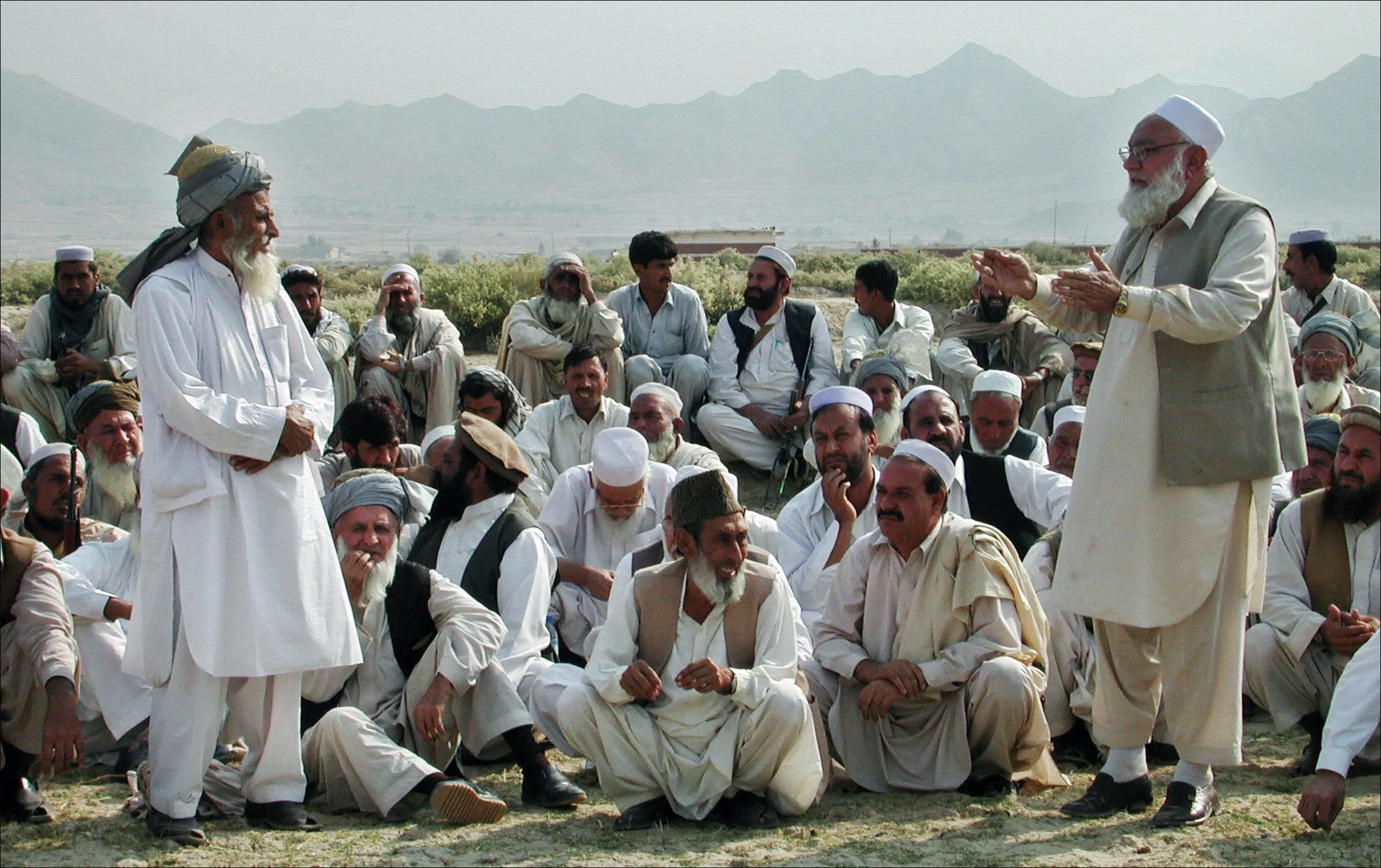
The Jirga system is a tribal dispute-resolution mechanism which utilizes the community’s personal customs and code of conduct to resolve disputes. It affords the authority of such a resolution to highly respected members of the community, and is a long-standing form of dispute resolution. In 2019, the Supreme Court (SC) of Pakistan declared the enforcement of its decisions to be illegal citing concerns as to human rights violations. This article argues that this prohibition should be replaced with appropriate legislation to streamline the application of jirga and overcome the human rights concerns associated with its practice.
Prior to 2019 the practice of Jirga had been given some statutory authority via the Frontier Crimes Regulation of 1901 (FCR). This authority was limited to the Federally Administered Tribal Areas (FATA) and permitted the involvement of the council of elders in resolution of minor disputes. Following the 25th Amendment of the constitution, FATA was merged with Khyber Pakhtunkhwa (KP) and the FCR was abolished, in its place the FATA Interim Regulations was temporarily put in place.
However, in the case of National Commission on the Status of Women v. The Government of Pakistan (PLD 2019 SC 218), the SC declared the Interim Regulations as ultra vires to the constitution. It further found the manner in which jirga and Panchayat function to be violative of article 4, 8, 10-A 25, and 175(3) of the constitution. The court, citing cases of honour killing and forced marriage of women, found the awards given by the jirga to be against fundamental rights. In particular the court stated the lack of uniform application of penalties and the use of women as means of penalizing the act of other is against article 10-A and article 25 of the Constitution.
The judgment, sought to limit the application of these jirgas to the extent of acting as a form of Alternative dispute resolution (ADR), prohibiting it application as a court. This decision specifically stated that jirga may only operate in the limits prescribed by law to the extent of civil disputes.
Despite the judgement prohibiting the use of jirga as a court jirga continues to be used as a quai-judicial authority. The use of jirga remains steadfast in Pakistan, not merely as a form of ADR, but as a de facto court. In 2026 jirgas continue to be used to resolve disputes such as the case of the Mahar and Jatoi tribes where a jirga was set up to resolve a years old feud between the two sides. This jirga penalized both sides with a fine proportionate to the loss suffered by them. A similar jirga was also set up to resolve an old blood feud between the Magnejo and Kalhoro tribes.
These instances showcase that communities continue to willingly bind themselves to the decision of the jirga despite no legal recognition being placed upon its award. Furthermore, a study by Nawaz & Aman (2022) titled ’Dispute Resolution Councils in Khyber Pakhtunkhwa: The Personification of Jirgas’, noted a discardable preference of community members towards jirga, notably due to its speed and simplicity. This suggests a presumed effectiveness as well as the trust held by it within the local communities.
Actions have been taken to prevent the implementation of coercive penalties however; the enforcement of the prohibition remains difficult due to its deep-rooted nature. This weakens the application of the rule of law, allowing room for the continued application of more coercive punishments. This can be seen with reports of women continuing to be forcibly married as means of dispute resolution being made till date. While actions have been taken to mitigate its harmful usage lack of statutory clarity and appropriate legislation makes such efforts difficult in practice.
The lack of trust held by the tribal communities in the police and court system, leads to their unwillingness to partake in litigation in place of the Jirga, which they have long grown accustomed to. This mistrust has been attributed to the association of these systems with a foreign imposition seeking to overturn their cultural norms.
Lack of willingness to stray from the practice of jirga does not in and of itself create problems. Instead, it is the coercive penalties which have often been attributed to jirga which require control. To allow for a balance to be made with the cultural practice of jirga and the judiciary systems should be set in place to regulate its practice while preserving judicial safeguards including the right to appeal, and the protection of rights of women.
To better understand how to formulate such a system example may be derived from the Kgotla in Botswana and Customary courts in Nigeria. Reference is made to these systems in particular due to their complementary institutional approach to the integration of informal customary justice within a state-regulated legal framework. While these systems are not perfect reference is made to them to the extent of looking into their redeeming features and attempting to implement them into Pakistan’s own framework.
The Kgotla is a legally recognized practice given recognition through the Customary Courts Act. The act dictates its jurisdiction, appeal process and sets clear limitations as to the types of penalties that may be imposed by it. Should similar clarity be given to tribal resolution mechanisms in Pakistan, a cohesive system may be formulated allowing for judicial oversight upon the practice.
Similarly, in Nigeria through the Federal Capital Territory Customary Court Act, 2007 Customary courts are provided set limitations to their jurisdiction, particularly regarding penalties, to ensure judicial autonomy. The key attributes of this which should be considered is the establishment of an overseeing authority to supervise and monitor the activities of the customary court. Through the appointment of such a supervisory authority as seen in Nigeria the primary issues of human rights concerns associated with the Jirga maybe mitigated.
Proper supervision through an appointed legal authority would allow the jirga to be held accountable should decisions contrary to the constitutional safeguards be found. Additionally, by ensuring the appointed authority be familiar with the customary law of the region a sense of alienation often associated with court intervention may be avoided.
Enabling legislation formulated using these principles would allow for the regulation of the Jirga without disregarding its customary value. When formulating this legislature limitations should be set as to the jurisdiction and penalizing power afforded to such bodies. Penal authority can be set to specific fines clearly defined to ensure consistency; simultaneously the protentional for harsher penalties can be set to be subject to enforcement by the court rather than jirga itself.
Clear prohibitions ought to be set for coercive penalties outside of the authority of the jirga, with penalties in place for any breach. Alongside all this a clear appeal form should be made available to ensure the protection of the right of fair trial.
Jirga, while having its flaws, does not need to be banned or stripped of all legal value. It is a practice which predates formal courts and has in many cases worked for the resolution of longstanding disputes. Through providing proper legislation for the regulation of jirga its practice may be preserved while ensuring the protection of individual rights.
- jirga
- customary justice
- alternative dispute resolution
- human rights
- judicial oversight
Cite this article
Anqa Ghalib, 'Regulating The Jirga: Integrating the Jirga into Pakistan’s Legal Framework' (DraftLaw Research, 21 October 2026) <https://draftlawresearch.org/articles/regulating-the-jirga-integrating-the-jirga-into-pakistans-legal-framework/>
Copyright remains with the authors unless stated otherwise.
About the author

Graduate in Law, Bahria University